What Should You Look for in a Vocational Nursing Program in California?
If you’re comparing vocational nursing programs in California, start with California Board of Vocational Nursing and Psychiatric Technicians (BVNPT) approval. Then look at NCLEX-PN outcomes, curriculum, clinical education, skills and simulation labs, program length, admissions requirements, costs, and student support. Because programs can differ significantly in structure and schedule, comparing the same factors across your options can help you make a more informed decision.
Why Should BVNPT Approval Come First?
BVNPT approval should be one of the first things you verify. The California Board of Vocational Nursing and Psychiatric Technicians is authorized to approve vocational nursing programs in the state and maintains a current list of approved programs.¹ Approval matters because it confirms that the program has met applicable California requirements for vocational nursing education.
When researching schools, verify the approval status of the specific campus and program you’re considering rather than relying only on a school’s general description. The BVNPT also advises students to contact individual programs directly for current information about courses, location, schedules, and fees.¹
How Should You Compare NCLEX-PN Pass Rates?
After completing an approved vocational nursing program and meeting applicable requirements, graduates pursue the NCLEX-PN as part of the California licensure process. NCLEX-PN pass rates can provide useful context about how recent graduates have performed. However, don’t look at the percentage alone. Compare:
- The reporting year
- Whether the figure is a first-time pass rate
- The number of graduates who tested
- Performance across several years
- Results for the specific campus you’re considering
A strong percentage based on a small group of test-takers provides different context from the same percentage based on a much larger graduating class. Most importantly, no school can guarantee that an individual graduate will pass the NCLEX-PN. Consider licensure outcomes alongside curriculum, clinical education, and academic support.
What Should You Look for in the Curriculum?
A vocational nursing curriculum should prepare you for the knowledge and responsibilities associated with LVN practice.
Common areas of study include:
- Nursing fundamentals
- Anatomy and physiology
- Pharmacology
- Medical-surgical nursing
- Maternal and pediatric nursing
- Gerontological nursing
- Rehabilitation
- Communication and documentation
When comparing programs, review how the curriculum progresses and how classroom learning connects with laboratory and clinical education. You may also encounter different credential structures. Some vocational nursing programs award a diploma, while others award an associate degree.
Both can provide a pathway toward California LVN licensure when applicable state requirements are met. However, an associate-degree program typically includes additional college-level coursework beyond the core vocational nursing curriculum.
How Important Is Clinical Education?
Clinical education is a major part of vocational nursing preparation. During supervised clinical experiences, you begin applying nursing concepts in healthcare settings while developing skills appropriate to your level of education.
When comparing programs, ask:
- Where can clinical rotations occur?
- How long are clinical shifts?
- Can rotations occur on weekends?
- How much travel may be required?
- Which types of healthcare settings may be used?
Clinical placements vary based on course requirements and site availability, so you should not assume a specific hospital, specialty, schedule, or location is guaranteed.
What Should You Know About Skills Labs and Simulation?
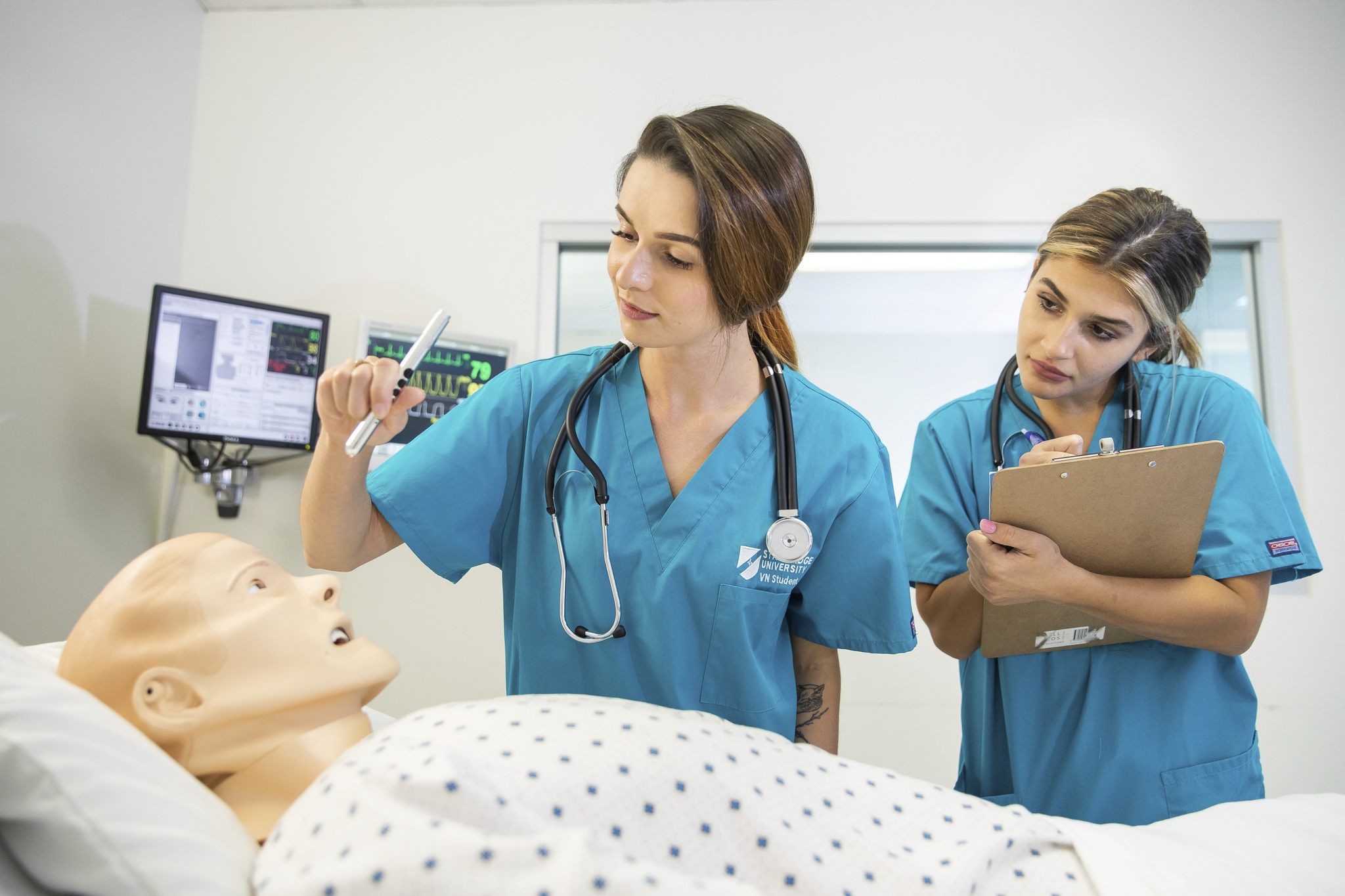
Skills labs and simulation give you opportunities to practice before and alongside clinical education. In a skills lab, you may work on individual techniques such as vital signs, medication-related skills, documentation, infection prevention, or patient-care procedures.
Simulation may combine several skills in realistic scenarios that require communication, assessment, prioritization, and clinical judgment. When comparing programs, consider not only what technology is available, but also how the program uses it to support learning.
How Long Does a Vocational Nursing Program Take?
Program length varies depending on the school, academic calendar, credential awarded, and whether you attend full-time or part-time. When comparing programs, ask:
- Is the schedule full-time or part-time?
- How many days per week are classes held?
- When are labs scheduled?
- Can clinical rotations take place in the evenings or on weekends?
- Does the stated program length include holidays and breaks?
A shorter program may be appealing, but schedule intensity matters too. A full-time program may take less time overall while requiring a larger weekly commitment.
What Admissions Requirements Should You Review?
Admissions requirements can vary considerably. Some vocational nursing programs accept applicants with a high school diploma or equivalent and do not require previous college-level prerequisites. Other programs may require entrance testing, prerequisite coursework, minimum academic standards, interviews, or additional application materials.
Review admissions requirements early so you understand how long it may take to become eligible to enroll. You should also verify background check, health, immunization, and other requirements associated with clinical education.
What Student Support Should You Compare?
Vocational nursing students balance classroom learning, lab practice, clinical rotations, and preparation for the NCLEX-PN. Consider whether programs provide resources such as:
- Academic advising
- Tutoring
- Faculty support
- Additional skills lab practice
- NCLEX-PN preparation
- Career services
Also ask when those resources are available. Support is most useful when you can realistically access it around your class and clinical schedule.
What Should You Know About Cost?
Compare the total cost of the program, not just tuition. Additional expenses may include books, uniforms, equipment, background checks, health requirements, transportation to clinical sites, licensing-related fees, and other required costs.
Ask each school for current cost information so you can make an equivalent comparison. You can also review available scholarships, payment options, and financial aid. Financial aid is available for those who qualify.
What Is the Career Outlook for LVNs in California?
California projects continued demand for licensed vocational nurses. According to the California Employment Development Department (EDD), LVN employment is projected to increase from approximately 78,100 positions in 2022 to 92,000 in 2032, representing 17.8% projected growth. The EDD projects approximately 78,260 total job openings during that period.²
The EDD also reports a median hourly wage of $39.41 for California LVNs in the first quarter of 2026.² Actual wages and employment opportunities vary based on employer, geographic location, experience, work setting, schedule, and other factors. Employment projections and wage data do not guarantee individual outcomes.
Stanbridge University’s Vocational Nursing Program
Stanbridge University offers an Associate of Occupational Science in Vocational Nursing at its Orange County, Los Angeles, Riverside, and San Diego campuses. The program is approved by the BVNPT at all four locations.³
The program combines classroom instruction, Nursing Skills Laboratories, high-fidelity simulation, and supervised clinical education. Courses may be delivered through on-campus, online, and blended learning environments.³
The curriculum consists of 106.5 quarter credit hours and is structured for completion in approximately 17–19 months full-time or 26–28 months part-time, depending on cohort scheduling and individual progression.³
Stanbridge also incorporates NCLEX-PN preparation throughout the program. Recent reported pass rates include a 94% three-year average for Orange County and 92% for Los Angeles for 2023–2025, while Riverside reported a 96% rate for 2025. Individual outcomes vary.³
If you’re considering the program, review the current admissions requirements, curriculum, schedule, costs, BVNPT approval, clinical expectations, and licensure outcomes directly on the Stanbridge University Vocational Nursing program page.
How Can You Compare LVN Programs Side by Side?
Once you’ve narrowed your options, compare the same information for every program:
| Category | What to Review |
| BVNPT Approval | Is the specific program and campus approved? |
| NCLEX-PN Outcomes | What are the recent first-time pass rates? |
| Curriculum | What nursing and general education courses are included? |
| Clinical Education | Where and when may clinical rotations occur? |
| Hands-On Learning | How are skills labs and simulation used? |
| Schedule | Is the program full-time, part-time, or both? |
| Program Length | What is the estimated completion time? |
| Admissions | What must you complete before enrolling? |
| Student Support | What academic and NCLEX-PN resources are available? |
| Cost | What expenses are included beyond tuition? |
Using the same criteria can help you evaluate programs more consistently instead of making a decision based on one feature alone.
Frequently Asked Questions
Start with BVNPT approval, then compare NCLEX-PN results, curriculum, clinical education, skills and simulation learning, program length, admissions requirements, costs, and student support.
Yes. You should verify that the specific vocational nursing program and campus are approved by the California Board of Vocational Nursing and Psychiatric Technicians.¹
Compare the reporting year, number of test-takers, whether the figure represents first-time candidates, and performance over multiple years.
Program length varies by institution and schedule. Stanbridge University’s program is structured for approximately 17–19 months full-time or 26–28 months part-time.³
California EDD projects LVN employment to grow 17.8% from 2022 to 2032, from approximately 78,100 to 92,000 positions.²
California EDD reports a median hourly wage of $39.41 for licensed vocational nurses in the first quarter of 2026. Actual earnings vary.²
Footnotes
¹ California Board of Vocational Nursing and Psychiatric Technicians, Approved Vocational Nursing Programs https://www.bvnpt.ca.gov/education/vocational_nursing_programs.shtml
² California Employment Development Department, Licensed Vocational Nurses Occupational Profile https://labormarketinfo.edd.ca.gov/cgi/databrowsing/occExplorerQSDetails.asp?searchCriteria=Nurse&careerID=&menuChoice=&geogArea=0601000000&soccode=292061&search=Explore+Occupation
³ Stanbridge University Associate of Occupational Science in Vocational Nursing https://www.stanbridge.edu/program/vn