The Anatomage Table and Modern Healthcare Education
Basic Overview
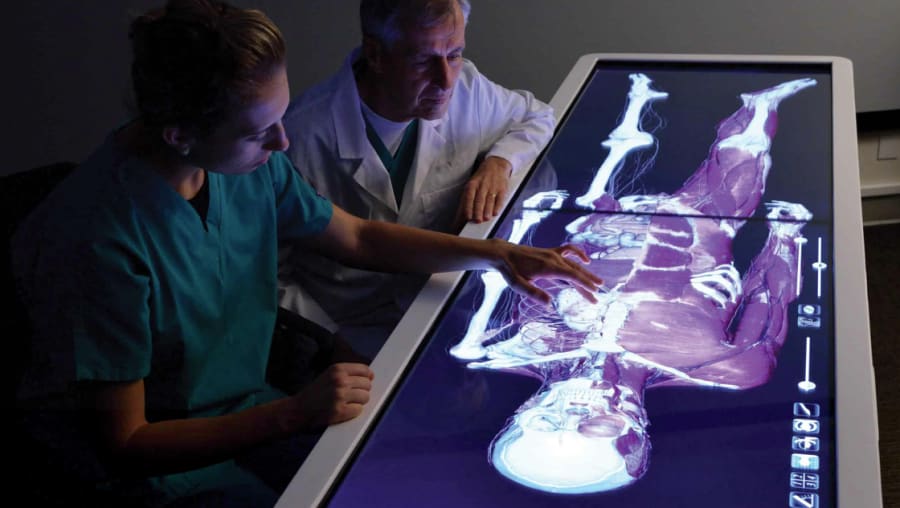
An Anatomage Table is an advanced anatomy visualization system that allows healthcare students to explore full-scale human anatomical models in a digital environment. By providing interactive anatomy learning experiences, the Anatomage Table helps students study body systems, anatomical structures, and spatial relationships in ways that complement traditional classroom instruction and laboratory education.
Why Is the Anatomage Table Important in Healthcare Education?
Healthcare education continues to evolve as institutions incorporate innovative technologies that support learning and student engagement.
One example is the Anatomage Table, a technology that supports anatomy education by helping students visualize body systems, examine anatomical relationships, and engage with anatomy concepts through interactive learning experiences.¹
For students pursuing careers in healthcare professions, understanding anatomy is an important part of their education. The Anatomage Table is one of several educational technologies used to support anatomy-focused learning experiences and enhance understanding of the human body.¹
What Is the Anatomage Table?
The Anatomage Table is a digital anatomy visualization system that allows students to study full-scale human anatomical models through interactive exploration and virtual dissection experiences.¹
Unlike traditional anatomy textbooks or two-dimensional images, the Anatomage Table allows students to view anatomical structures in three dimensions and examine relationships between body systems from multiple perspectives.
Students can explore:
- Skeletal structures
- Muscular systems
- Organs and organ systems
- Blood vessels
- Nerves and connective tissues
The technology is designed to help students visualize anatomy in ways that complement classroom instruction and laboratory learning.
How Is the Anatomage Table Used in Healthcare Education?
Many healthcare professions require a strong understanding of anatomy and physiology.
The Anatomage Table supports anatomy education by allowing students to:
- Explore body systems in three dimensions
- Study anatomical relationships between structures
- Visualize complex anatomy from multiple perspectives
- Reinforce concepts introduced through lectures and coursework
- Participate in interactive anatomy learning experiences¹
As a result, students can engage with anatomical concepts through multiple learning methods while developing a deeper understanding of the human body.
How Is the Anatomage Table Different from Traditional Anatomy Learning?
Traditional anatomy education often includes textbooks, diagrams, lectures, models, and laboratory instruction.
In contrast, the Anatomage Table provides a digital anatomy visualization experience that allows students to interact with anatomical structures in a dynamic environment.¹
While traditional teaching methods remain important, educational technologies such as the Anatomage Table provide additional opportunities to explore anatomy in interactive and visual ways.
The goal remains the same: helping students understand how body systems function and interact.
Why Is Anatomy Education Important in Healthcare Programs?
Anatomy serves as a foundation for many healthcare professions.
Professionals in fields such as nursing, occupational therapy, physical therapy, and rehabilitation sciences regularly apply anatomical knowledge when evaluating patients, supporting treatment plans, and participating in patient care.²
Understanding anatomy helps students:
- Recognize body structures and systems
- Understand physiological processes
- Connect classroom concepts to healthcare applications
- Develop a stronger foundation for clinical education experiences²
Consequently, many healthcare programs incorporate a variety of anatomy-focused learning resources.
Innovation and Technology at Stanbridge University
Stanbridge University incorporates innovative educational technologies across healthcare programs to support student learning.¹
The Virtual Reality Lab at Stanbridge University features the Anatomage Table, one of the most advanced anatomy visualization systems available in healthcare education. Stanbridge University was the first university on the West Coast to acquire an Anatomage Table. Students can use the technology to explore full-scale human anatomical models and participate in virtual dissection experiences.¹
Additionally, Stanbridge University’s Innovation & Technology resources include:
- SynDaver Synthetic Cadavers
- Nursing Simulation Laboratories
- High-Fidelity Simulations
- Rehabilitation Robotics
These technologies are designed to complement classroom instruction and support hands-on learning experiences across healthcare disciplines.¹
How Is Healthcare Education Continuing to Evolve?
Healthcare education continues to evolve as institutions explore new ways to support learning and engagement.
While traditional teaching methods such as lectures, textbooks, anatomy models, laboratory instruction, and classroom discussions remain important, technologies such as the Anatomage Table provide additional opportunities for students to explore anatomy, visualize body systems, and engage with healthcare concepts through interactive learning experiences.
As a result, educational technology continues to play an increasingly important role in modern healthcare education by complementing established teaching methods and supporting multiple approaches to learning.
Frequently Asked Questions
The Anatomage Table is a digital anatomy visualization system that allows students to explore full-scale human anatomical models and participate in virtual anatomy learning experiences.¹
Students use the Anatomage Table to study anatomy, explore body systems, visualize anatomical relationships, and reinforce concepts introduced through classroom instruction.¹
Yes. The Anatomage Table allows students to participate in virtual dissection experiences while exploring detailed anatomical structures and body systems.¹
Anatomy helps healthcare students understand body systems, physiological processes, and relationships between anatomical structures. Consequently, anatomy education serves as a foundation for many healthcare professions.²
Nursing, occupational therapy, physical therapy, rehabilitation sciences, and many other healthcare professions incorporate anatomy education as part of their curriculum.²
Students can explore Stanbridge University’s Innovation & Technology resources to learn more about the Anatomage Table, Virtual Reality learning environments, Synthetic Cadavers, and other educational technologies.¹
Footnotes
¹ Stanbridge University Innovation & Technology, https://www.stanbridge.edu/innovation-technology
² National Library of Medicine (NLM) and National Center for Biotechnology Information (NCBI) Anatomy and Healthcare Education Resources, https://www.nlm.nih.gov/, https://www.ncbi.nlm.nih.gov/