What Is Evidence-Based Practice in Occupational Therapy?
Evidence-based practice (EBP) in occupational therapy is the integration of current research evidence, clinical expertise, and the client’s preferences and values to inform professional decision-making.¹ Rather than selecting an assessment or intervention solely because it is familiar, occupational therapy practitioners critically consider the available evidence alongside the client’s occupational goals, clinical presentation, environment, and individual circumstances.

What Are the Main Components of Evidence-Based Occupational Therapy?
Evidence-based occupational therapy brings together research, practitioner expertise, and the individual client rather than allowing any single source of information to determine care.¹
| Component | Role in Occupational Therapy |
| Research Evidence | Provides current findings about assessments, interventions, outcomes, and practice approaches |
| Clinical Expertise | Helps the practitioner interpret evidence and apply professional reasoning |
| Client Values and Preferences | Centers intervention around meaningful goals, priorities, and occupations |
| Clinical Context | Considers the environment, available resources, practice setting, and other factors affecting care |
These components are interdependent. Research may support a particular intervention, for example, but the practitioner must still determine whether it is relevant to the client’s occupational goals and clinical presentation.
Likewise, an intervention that is familiar to a practitioner should not automatically be selected if stronger evidence supports another approach.
How Do Occupational Therapists Use Evidence-Based Practice?
Occupational therapists use EBP by translating clinical questions into focused searches for evidence, critically appraising what they find, and determining how relevant findings apply to an individual client.
The process can be summarized as:
- Identify the clinical question.
- Determine what information is needed to guide evaluation, intervention, or another professional decision.
- Search for evidence.
- Locate relevant research, systematic reviews, practice guidelines, or other credible clinical resources.
- Critically appraise the evidence.
- Evaluate the quality, relevance, limitations, and applicability of the available information.
- Integrate the evidence.
- Consider research findings alongside clinical expertise and the client’s values, priorities, and circumstances.
- Evaluate outcomes.
- Monitor whether the intervention is supporting the intended occupational outcomes and modify the approach when appropriate.
AOTA develops occupational therapy practice guidelines from systematic reviews of evidence. These guidelines translate research findings into clinical recommendations that practitioners can use alongside their expertise and the client’s values and preferences.²
What Is an Example of Evidence-Based Practice in Occupational Therapy?
Consider an adult who wants to regain independence in meal preparation after a neurological injury.
An occupational therapist would not select an intervention based only on the diagnosis.
Instead, the OT might consider:
- The client’s specific meal-preparation goals
- Motor and cognitive abilities
- Home environment
- Safety considerations
- Available research on relevant interventions
- Assessment findings
- Client preferences
- Response to previous intervention
Current evidence might support particular cognitive strategies, task-specific training, environmental modifications, or adaptive approaches. However, the OT still needs to determine which strategies align with the client’s occupational priorities and clinical needs.
That integration is central to evidence-based occupational therapy: research informs the decision, but the client and clinical context shape its application.¹

Why Does Evidence-Based Practice Matter in Occupational Therapy?
Evidence-based practice helps occupational therapy practitioners provide care that is informed, current, client-centered, and responsive to evolving professional knowledge.¹
It supports:
- Clinical decision-making
- Client-centered intervention
- Quality of care
- Professional accountability
- Outcome evaluation
- Practice improvement
- Lifelong learning
It can also help practitioners identify approaches that should no longer be routinely used. AOTA’s Practice Smart! initiative, for example, encourages practitioners to discontinue interventions that are ineffective, unsafe, or unsupported by evidence and replace them with approaches grounded in current best practice.³
This illustrates an important part of EBP: evidence can influence not only what practitioners should do, but also what they should reconsider or stop doing.
How Do Occupational Therapy Students Learn Evidence-Based Practice?
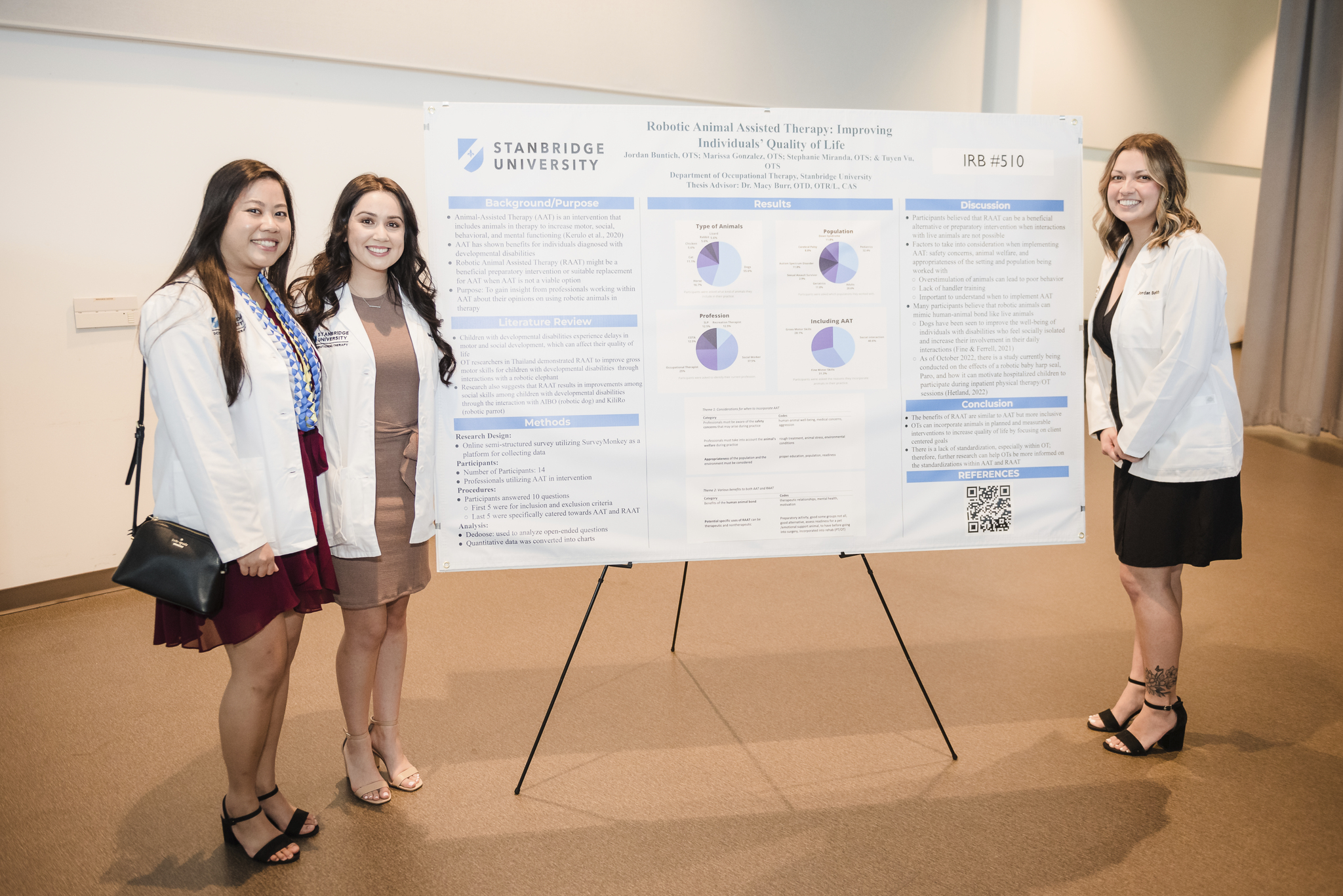
Graduate occupational therapy education develops the ability to critically analyze research and integrate evidence into clinical reasoning, assessment, and intervention planning. Stanbridge University’s Master of Science in Occupational Therapy program curriculum includes a dedicated Evidence-Based Practice course.⁴
The MSOT program learning outcomes also require graduates to analyze and implement current evidence-based assessments grounded in occupational therapy theory and research and to design and deliver best-practice interventions based on factors influencing occupational performance.⁵
Evidence-based clinical reasoning is reinforced through case studies, technology, interdisciplinary learning, laboratory experiences, and fieldwork.⁵
This graduate-level preparation is important because occupational therapists are responsible for evaluation, interpretation of assessment findings, intervention planning, and professional decision-making. Rather than simply learning a collection of interventions, MSOT students develop the ability to examine whether, why, and for whom an intervention is appropriate.
Why Does Evidence-Based Practice Matter for Future Occupational Therapists?
Occupational therapy practice continues to evolve as new research, technologies, assessment approaches, and intervention evidence emerge. As a result, graduate education cannot prepare future occupational therapists by teaching only what is currently known.
It must also prepare them to find, evaluate, interpret, and apply new knowledge throughout their careers. Evidence-based practice provides that framework.
For future OTs, the essential question is not simply:
“What intervention can I use?”
It is:
“What does the evidence suggest, how strong is that evidence, and how should it be integrated with this client’s occupational priorities and clinical context?”
That distinction moves evidence-based practice beyond research literacy. It makes EBP part of clinical reasoning, professional accountability, and client-centered occupational therapy.
Students interested in graduate occupational therapy education can explore Stanbridge University’s Master of Science in Occupational Therapy program.
Frequently Asked Questions
No. Evidence-based practice integrates research with clinical expertise and the client’s preferences, values, goals, and circumstances. Research informs professional decision-making rather than replacing clinical reasoning.¹
Occupational therapists may use systematic reviews, practice guidelines, research studies, critically appraised evidence, professional resources, and other credible sources. AOTA also publishes practice guidelines and evidence-based clinical resources for occupational therapy practitioners.²
Practitioners critically appraise evidence by examining factors such as study design, methodological quality, relevance, limitations, and applicability to the clinical question. Graduate OT education helps students develop these research-appraisal skills.
Yes. New evidence can support changes in assessment, intervention, documentation, or other areas of practice. AOTA’s Practice Smart! recommendations specifically address practices that should be reconsidered when they are ineffective, unsafe, or not supported by current evidence.³
Yes. Stanbridge University’s MSOT curriculum includes a dedicated Evidence-Based Practice course, and its program learning outcomes emphasize evidence-based assessment, research, best-practice intervention, and clinical reasoning.⁴ ⁵
Footnotes
¹ American Occupational Therapy Association, Practice Improvement: Evidence-Based Practice & Knowledge Translation, https://www.aota.org/practice/practice-essentials/practice-improvement
² American Occupational Therapy Association, Practice Guidelines and Evidence-Based Clinical Resources https://www.aota.org/practice/practice-essentials/evidencebased-practiceknowledge-translation/practice-guidelines
³ American Occupational Therapy Association, Practice Smart! https://www.aota.org/practice/practice-essentials/evidencebased-practiceknowledge-translation/practice-smart
⁴ Stanbridge University Catalog, Master of Science in Occupational Therapy Program Overview https://catalog.stanbridge.edu/programs/msot-program/msot-program-overview/
⁵ Stanbridge University Catalog, Master of Science in Occupational Therapy General Information https://catalog.stanbridge.edu/programs/msot-program/msot-general-information/